Context: Molecular analysis has recently become one of the cornerstones of management of endometrial carcinoma. While the main purpose of tumor genetic testing is to identify eligibility for emerging targeted therapies, this information is valuable in understanding the molecular mechanisms of cancer progression. In this study, we investigated the molecular determinants of prognosis in endometrial malignancies.
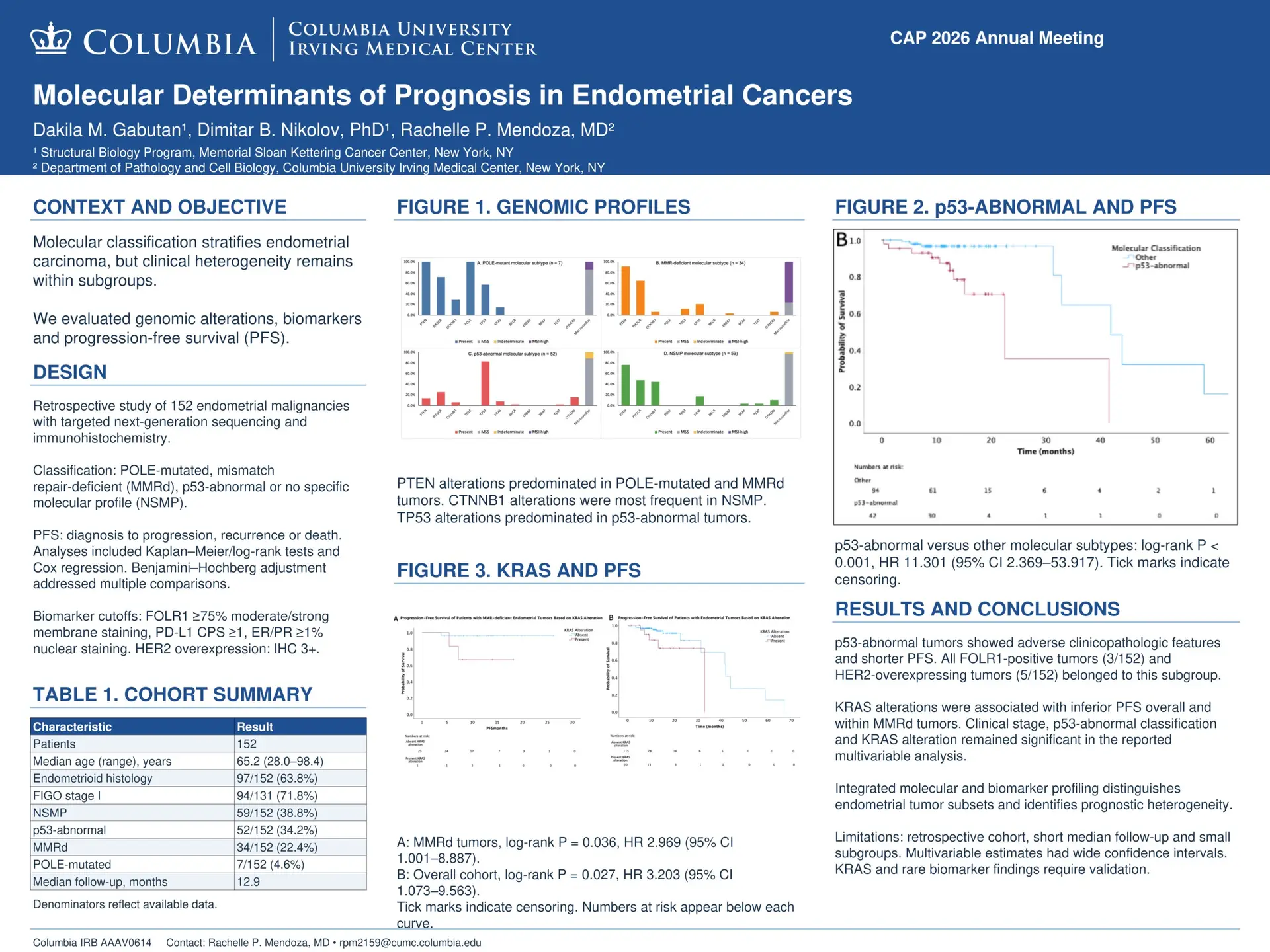
Design: 152 endometrial cancer cases were evaluated for molecular alterations using next-generation sequencing. Tumors were classified as no specific molecular profile (NSMP; n=59, 39.1%), p53-abnormal (n=51, 33.8%), mismatch repair-deficient (MMRd; n=34, 22.5%), or POLE-mutated (n=7, 4.6%). Correlations between molecular results and relevant clinicopathologic features were performed.
Results: After false discovery rate correction, molecular subtypes differed significantly in histologic type and grade, pathologic T stage, lymphovascular invasion, selected genomic alterations, and immunophenotypic profiles. P53-abnormal tumors demonstrated the most adverse clinicopathologic phenotype and contained all FOLR1-positive (n=3) and HER2-positive (n=5) tumors, although only the HER2 association remained significant after correction. NSMP tumors were predominantly low-grade endometrioid carcinomas and frequently harbored PTEN and CTNNB1 alterations and progesterone receptor expression, whereas MMRd tumors frequently harbored PTEN and PIK3CA alterations. All seven POLE-mutated tumors harbored PTEN alterations and were PD-L1 positive. Among 141 patients evaluable for progression-free survival (PFS), 38 events occurred. KRAS alteration was associated with inferior PFS by Kaplan-Meier analysis (P=0.010) and univariable Cox regression (HR, 2.57; 95% CI, 1.22-5.40; P=0.013). After adjustment for clinical stage and histologic grade, KRAS alteration remained associated with inferior PFS (HR, 5.47; 95% CI, 1.90-15.73; P=0.002), whereas p53-abnormal classification was not independently associated. Advanced stage remained the most consistent adverse prognostic factor across the separate adjusted Cox models. These findings identify distinct molecular-subtype profiles and support KRAS alteration as a potential adverse prognostic modifier requiring independent validation.